Kendrick Lamar has changed Super Bowl Halftime shows forever. But will it ever be allowed again?
- Feb 10, 2025
- 7 min read
Updated: Sep 11, 2025
The last thing Roger Goodell and the National Football League wanted at Super Bowl LIX was a political showcase. With President Donald Trump in attendance, and America tearing itself apart in racially motivated fear and anger, they went into the performance with an eye toward attracting that younger demographic and having what would be a memorable performance aimed at insuring they stay on top of the sports and entertainment ladder.
What they got was not what they likely wanted, but should have expected. Perhaps deep down they wanted this message to be seen and heard. Perhaps they wanted Trump to feel uncomfortable, and didn’t give a damn what his followers thought. Perhaps they were seeking to send a message and the fallout be damned.
Then again, perhaps they miscalculated. Either way, what America got and what Trump and America had shoved sure in the face was a protest performance for the ages.
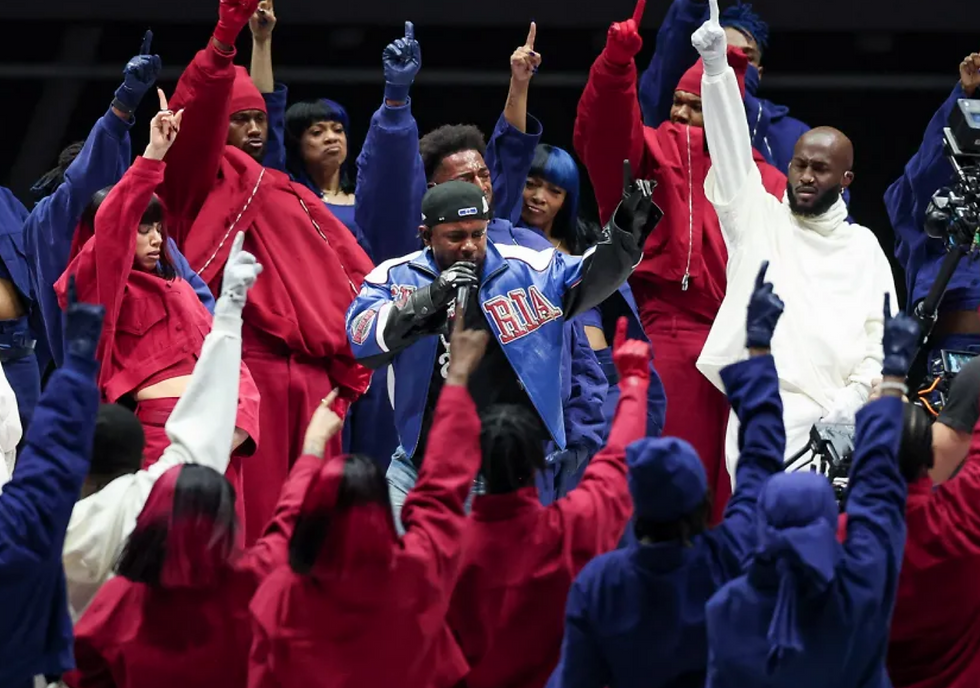
Kendrick Lamar's 2025 Super Bowl halftime performance was a profound and provocative display of artistry, rich in symbolism and social commentary. Building upon his 2022 appearance, Lamar elevated his message, delivering a performance that was both a personal narrative and a broader critique of societal issues.
It wasn’t made for white America, though Lamar no doubt hoped it would ignite these conversations and force that demographic to listen and learn. Granted, it was all the more difficult for many to understand the lyrics. Most people had no idea what was said until it was texted and analyzed the next day. But in that being part of the entire performance, Lamar got his wish.
Everyone is still talking about it, and whether you love or loathe Kendrick Lamar or rap music, the words and symbolism are powerful, indeed. All you have to do is pay attention.
Stage Design and Symbolism
The stage was configured in a tic-tac-toe design, with Samuel L. Jackson portraying Uncle Sam, underscoring the event's significance. This setup served as a visual metaphor for the strategic battles faced by marginalized communities within the American system. The choice of Jackson as Uncle Sam highlighted the performance's focus on American identity and the complexities therein. There is no question a point was being made that in a true America, Uncle Sam can and should be whatever you perceive him to be, standing for righteousness and freedom from oppression.
Costumes and Choreography
Lamar's dancers donned solid red, white, and blue outfits, forming an American flag during the performance. This act symbolized the unity and division within the nation, with Lamar's position dividing the dancers possibly representing the societal rifts present today. The choreography, marked by intense focus and intricate movements, conveyed a sense of anxiety and the feeling of being constantly observed, reflecting the scrutiny faced by Black individuals in America.
There’s a connection to what Lamar put on display during his 2022 Super Bowl performance. Back then, the most notable part of the performance came during Lamar’s song "Alright," an anthem of Black empowerment and resistance that has been linked to the Black Lives Matter movement. The lyrics “We gon’ be alright” echoed across the stadium, signaling not just hope, but a refusal to be crushed by the weight of institutionalized racism. The song itself has become a rallying cry, and its inclusion in the Super Bowl halftime show was a direct message to the audience—both those watching at home and those in attendance—that despite the challenges, the struggle for racial justice is ongoing and that, as a people, "we gon' be alright.”
That struggle is far from being resolved, and the 2025 performance made that crystal clear.
Political Undertones and Direct Messages
Throughout the performance, Lamar subtly addressed politics, referencing his journey from Compton and incorporating symbolic gestures such as the Black Power salute. A notable moment involved a dancer displaying a flag for Gaza and Sudan, which was quickly addressed by security and the NFL, highlighting the contentious nature of political expression in such a prominent setting.
If the NFL actually thought they would escape this halftime without some form of visual protest, they are more naive that anyone would imagine. Security was certainly on alert for something like this, but even in a few seconds, the damage was done. The NFL had become part of, and a willing participant in, a political protest.
Feud with Drake: A Personal Protest
While it was expected Lamar would take his shot in his long running feud with Drake, this was perhaps the weakest part of the performance. While the audience and critics got what they wanted through the diss track "Not Like Us.”, it seemed to be little more than a personal gripe moment and out of context with the protest feel of the show. It was a bridge and a bone of hubris tossed to his ego and fans, little more.
The Context: A Protest Performance
Kendrick Lamar’s Super Bowl performance wasn’t crafted for mass appeal. It wasn’t about pleasing the older, more conservative demographic of the Super Bowl’s vast audience. Instead, it was a message directed at the political and cultural elites, particularly those who championed the rise of Donald Trump and the divisive politics of his presidency. With the presence of Trump’s MAGA supporters at the game, Lamar's show was designed as a direct protest—whether they understood it or not.
This wasn't the first time a musical artist used a major public performance as an act of protest. Consider Sinead O'Connor’s infamous 1992 appearance on "Saturday Night Live," where she ripped up a picture of the Pope. That moment shocked the nation and made headlines for weeks, but O'Connor’s protest against child abuse in the Catholic Church spoke volumes about standing up against systemic power structures. Similarly, Kendrick Lamar’s performance sought to call out the powerful—particularly those who benefit from inequality—and to force the audience to confront uncomfortable truths.
In contrast to O'Connor’s radical move, Lamar's protest was much more layered. His protest was not about a single institution or figure—it was about the systems that uphold racial inequality and violence. It was a critique of an America that, under Trump’s influence, has become increasingly divided along racial, economic, and political lines.
Comparing to Other Protest Performances
In the history of protest performances, few are as impactful as those made by musical artists during times of political upheaval. From Bob Dylan’s 1963 protest song “Blowin’ in the Wind", to John Lennon and Yoko Ono performing “Give Peace a Chance” at a hotel room in Montreal surrounded by fellow musicians, artists have always used their platform to speak truth to power. In the modern context, performances like Lamar’s are both a continuation of this tradition and a reflection of the current political landscape.
Lamar’s Super Bowl halftime show brought protest to one of the world’s largest stages, where athletes, celebrities, and politicians gather, but it also opened up a conversation about what it means to use an entertainment platform for activism. While performers like Beyoncé and Colin Kaepernick have faced backlash for their activism, Lamar’s show managed to deliver a powerful message in a way that was unapologetic but not aggressive.
The political overtones were clear without being overbearing, challenging the status quo in a moment of mass exposure.
Will the Message Be Heard?
One question that lingers after Kendrick Lamar’s halftime show is whether the audience—particularly those in the MAGA camp—will ever truly hear the message. There’s little doubt that his performance was aimed squarely at those who support Donald Trump, whose administration emboldens racial divisions in America. But whether those people will ever reflect on the symbolism of Lamar’s performance, let alone change their views, is uncertain.
History shows us that protest performances often struggle to be understood by those they target. The backlash to the 1968 Olympic Black Power salute, or the fury over Sinead O'Connor’s protest against the Catholic Church, demonstrates how hard it can be to get a protest message across to a resistant audience. The sad reality is that many in the audience likely didn’t interpret Lamar’s performance as a political statement at all, at least not in the way it was intended.
Impact on Super Bowl Halftime Shows
Lamar's performance has undeniably shifted the paradigm of Super Bowl halftime shows, infusing them with political discourse and social commentary. This change challenges the NFL's traditional preference for apolitical entertainment, pushing the boundaries of what is acceptable in mainstream performances. While it remains to be seen how future halftime shows will navigate this new landscape, Lamar's 2025 performance has set a precedent for integrating meaningful messages into widely viewed events.
Kendrick Lamar's 2025 Super Bowl halftime show was a deliberate and powerful protest performance. Through thoughtful symbolism in stage design, costumes, choreography, and song selection, Lamar addressed pressing societal issues and personal grievances. His performance not only challenged viewers to reflect on these topics but also redefined the expectations for future halftime shows, embedding political and social commentary into the fabric of mainstream entertainment.
The NFL has tried for many years to be as apolitical as possible. Whether by design or accident, the 2025 halftime show strayed as far afield as possible in that thinking.
We’ll find out in years to come whether this was subtly planned or tossed at them without much warning. That will become evident beginning with halftime in 2026. I'm not a fan of his music. Never will be. Then again, I'm sure Lamar won't lose any sleep over it. Suffice to say when it comes to the protest, I get it. I only wish more of those outside his intended demographics took time to learn what was actually being said.
Ed Berliner has always been known to friends as "The Music Man", with several thousand CD's, vinyl albums, and a jam-packed IPod always at the ready. While he readily admits to not liking a single rap album or song, he always looks into the meaning behind such performances, with this one having more than a few connections to personal brand and messaging. Contact Ed today via the clicks here on this site and talk to him about bringing such thought-provoking conversation to your event and meeting. Also stay up on the real news


Thanks for the post, Ed. I didn't fully understand Kendrick's halftime show and posted that on my facebook. Soon I had lots of FB followers posting the meaning of the performance, complete with symbolism, BLM, etc... I'm grateful I reached out. I can't imagine what the NFL is planning to do in the future. Perhaps they'll have artists perform their acts before, hand so they can censor it. Wouldn't that be ironic.
Not to be left out, Kendrick is a pulitzer prize winner. That certainly gives him some cred.' I wonder if he'll be performing at the John F. Kennedy Arts Center?