Clickbait & Social Media Posts are NOT News, so Stop Playing Media Dress-Up
Content Creators & the Duping of America
WHY THIS MATTERS
We are living through a profound change in how people receive information. As traditional newsrooms shrink and social platforms increasingly determine what millions of people see, the distinction between creating content and doing journalism has never mattered more. If audiences can't tell the difference between reporting and entertainment, commentary and fact, verification and viral nonsense, then the people controlling the narrative aren't necessarily the people who know the truth—they're the people who know how to get your attention.
_____________________________________
Let's put up a wall. A really simple one.
CONTENT CREATOR ≠ JOURNALIST.
There. Now let's stop pretending. A person with a smartphone, a microphone, a TikTok account and three million followers is not automatically a journalist. In many cases, they're not even in breathing distance.
Neither is the person who sits in Mom's basement with a ring light, a bag of Doritos and a burning desire to tell the world what he thinks about nuclear war. You can always tell he's guessing by how orange-stained his (or her) fingers are.
That's a content creator. Could be a very successful one, or maybe even a very entertaining one at that.
However, and this is where the rubber starts to hit the road.
All that success isn't journalism, and judging by some of the wags and wonkettes handed a very important designation, neither is a White House credential.
You see, dear reader, journalism is work. Hard work. Real work. Time-crushing work. The type that grabs you by the throat and refuses to let go until you've found the niche, the story and the meaning.
I've spent more than four decades doing this, both on tv, radio and in print. The most important thing I learned is that real journalism isn't particularly glamorous.
It's making the phone call nobody wants to take, knocking on the door, finding the document and triple-checking to be certain it's the real magilla.
It's calling another source. Then another. And another. maybe even a fourth one, just to be certain. It's discovering that the great story you thought you had isn't actually true, and having the discipline to kill it. It's going back when everyone else has gone home because something doesn't make sense. Then it's asking the question that makes somebody very uncomfortable.
It's digging, digging, and digging some more. It's a relentless chase for the truth.
Because the story is supposed to be more important than the person telling it.
That's the greatest difference between what "creators" deliver and real journalists hammer out.
The Society of Professional Journalists' ethics standards call for verification, original sources, context, independence and accountability. Those aren't quaint traditions from the newspaper era. They're the basic disciplines that make information trustworthy.That makes US trustworthy. That will make YOU trustworthy.
Which makes what we've created all the more embarrassing and dangerous.
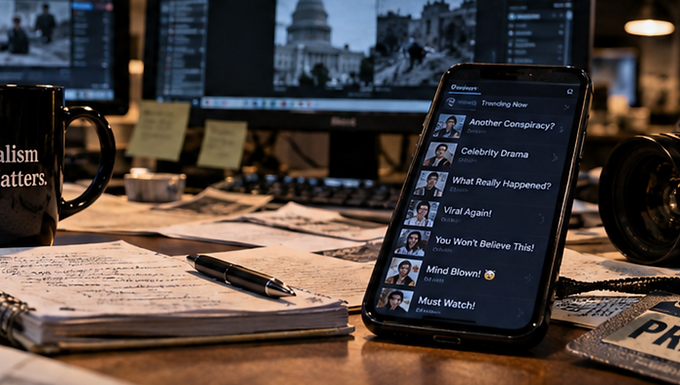
A phone screen doesn't care whether you're watching a report about a potential nuclear confrontation or a video explaining why a celebrity wore the wrong dress to an awards show.
Swipe.
Next story.
War.
Celebrity gossip.
Election.
Conspiracy.
Cooking.
Celebrity gossip again.
Somebody screaming into a camera about something they haven't bothered to verify.
It's all content, and the algorithm doesn't care which one matters. All it cares about is which one keeps you watching. Just don't ask questions and CONSUME PRODUCT.
That's how we got here. Views became credibility. Followers became expertise.Virality became verification, and none of those things are the same.
Which brings us to the White House part of this rant and roll.
The White House has embraced the changing media landscape, opening credentials to independent wonks without a lick of actual news-sourcing skills, podcasters who caught the attention of Trump sycophants because they report everything favorable about the man, social-media influencers and content creators producing what they crow is "news-related material" when in truth they may as well be delivering it into the camera wearing a Michael Myers Halloween mask. The administration says Americans increasingly get information through these questionable platforms, and they're not entirely wrong.
Fine.OK. I get it. The media landscape has changed, and sometimes new voices deserve consideration. But for all that is holy on the soul of Edward R. Murrow, the level of actual news credibility from these people just one day removed from the drive-thru window at Wendy's is about as reputable of whatever that so-called hamburger is actually made of.
Here's the question: What makes somebody a journalist?
Followers? Podcast? Screaming TikTok account, a big blue checkmark next to their profile?
How about instead the willingness to do the hard work instead of asking AI to print it for you.
Because those are very different things.
While all this is happening around us every day, real newsrooms are getting smaller.
Local journalism is being squeezed by greedy corporate masters who have the journalism sense of a stale donut. Staffs are being cut, people are being asked to do multiple jobs, automation and AI are entering newsrooms, and the people who spent years learning how to report on a city, from a courthouse, questioning law enforcement or back a lying politician into a corner at the statehouse are rapidly disappearing.
When the professionals leave, something has to fill the vacuum, and usually thanks to those fat cat ownership groups, it's content. ANY kind of content, so long as it's faster, cheaper, louder, and did I say cheaper?
That's the kind of pablum that often has absolutely no obligation to get it right. Just entertain, grab those clocks, and as I noted before, CONSUME PRODUCT.
That's where we have to be careful, because a person can make a terrific video without knowing a damn thing about journalism. Millions of people will watch it and take whatever nonsense proffered as fact.
Better write this one out loud before certain people start tuning up.
I'M NOT ATTACKING CONTENT CREATORS. Seriously.
Go create, entertain, make people laugh, talk about fashion, review restaurants, build a following, make a fortune and knock yourself out.
But if you for one moment want to tell people “I'm giving you the news,” then act like a journalist or put well worn sock in it.
Learn to verify. Learn to source. Learn to separate fact from opinion. Learn to admit when you're wrong. Learn to correct the record.
Then learn something every legitimate reporter learns very quickly: The story isn't about you.
Get that? Let it sink in.
The story is about the story.
That's why this matters beyond journalism, because you are creating a narrative about yourself, too.
Every post, every video, every stupid stunt you thought was hilarious at 23 years of age and every outrageous thing you did because somebody said it would go viral.
It's all part of the record.
It's your narrative.
Maybe today you're the girl who drew something obscene on her face for a laugh and got five million views. Ten years from now, somebody may simply see the headline: “OH, so THAT'S who she is. What a clown show”.
You don't get to control what people remember. You can only control what you give them to remember.
So draw the line with me.
Content is not journalism. Popularity is not credibility. A following is not verification. A camera doesn't make you a reporter.
If you want to be a journalist, stop screwing around and do the work. Don't tell me how many people watched. Tell me how many sources you checked.
Don't tell me how quickly you posted. Tell me how carefully you verified.
Don't tell me you're an influencer. Tell me what you actually know.
Because in the end, the most important question isn't: “Did it go viral?”
It's:“Is it true?”
That's where the narrative begins, and that's where journalism still matters.
BE DANGEROUSLY INTELLIGENT: CONTROL THE NARRATIVE™