The most powerful man in the world reveals a petty weakness
Donald Trump's narrative is one of a man running scared
America and the world are being denied the truth yet again
PROLOGUE: Why This Matters
The First Amendment protects freedom of the press, but press access to the White House also involves practical limitations because space is often limited. The constitutional question becomes particularly important when access is restricted because of the viewpoint or content of a news organization's reporting.
That isn't theoretical. In the 2025 Associated Press case, a federal judge held that the government could not shut journalists out of certain presidential events because of their viewpoint, although subsequent appellate proceedings complicated the practical effect of that ruling.
______________________________
THE DEEP DIVE
The email message from a good friend and colleague made what was a casual day at my desk and jarred me back into more than a few moments of in-depth consideration.
"So then, is Donald Trump merely following your suggestions in controlling the narrative?"
I immediately alternated between rage and thoughtfulness because, in a very small sense, he was correct. That is, if you simply take those words "control the narrative"without any sense of context. Without that, what has been my writing and speaking on the subject had been turned somewhat dark and, to a point, dangerous.
That's because there is a fundamental difference between controlling your narrative and controlling the people who tell the story.
One is leadership, something to be admired and emulated. The other should concern everyone, and force us to take a second look.
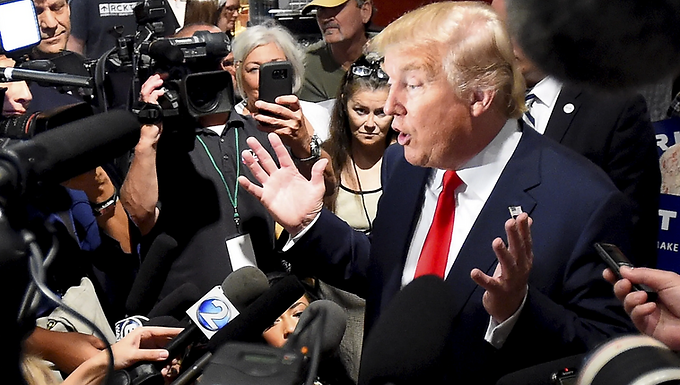
President Donald Trump has announced that CNN, MS NOW and Politico are banned from the White House, accusing the organizations of reporting what he calls “FAKE NEWS” and “FICTION and LIES.” He has also indicated that other news organizations could face the same treatment. Reporters from the three organizations were then subsequently denied access to the White House grounds, and a new level of constitutional crisis is in full play.
This isn't merely another fight between Donald Trump and the news media.He's made them a point of his attacks since he descended the golden staircase and discovered it was easier to lie than tell the truth.
This is a fight over something much larger and much more serious.
Who controls access to information about the people who hold power?
That is where controlling the narrative goes from being something we should all be concerned with for our personal and professional reputations, to something that is inherently dangerous.
Before we roll this out, let's be very clear about something.
News organizations are not above review and criticism. CNN, MS NOW, Politico, The New York Times, FOX News, the Associated Press, even me, we all should be held to account for what we write and what we say. That's the challenge we face as legitimate journalists is knowing that line of trust and never erasing it.
Journalists make mistakes. Editors make bad calls. Reporters get things wrong. News organizations have biases, institutional cultures and competing pressures.
That's why journalism requires verification, documentation, corrections, transparency and accountability. Every single time, without fail.
But there is an enormous difference between challenging journalism and punishing journalists for what they report.
The first is part of a free society, and the second raises a constitutional question that has already reached federal court.
In 2025, the White House restricted Associated Press access after the organization declined to adopt the administration's preferred terminology for the Gulf of Mexico, insisting it was now the "Gulf of America"without any logical reasoning save Trump was once again using phony patriotism as a hook for the gullible.
A federal judge didn't agree, ruling that the AP was likely to succeed on its First Amendment claim, finding that the government could not exclude the organization from certain press access because of its viewpoint.
The viewpoint that says history matters.
The principle isn't, “Do I like this news organization?”
The principle is. “Can the government use its power to punish a news organization because it doesn't like what that organization reports?”
Here's where we move into dangerous territory.
I've spent decades on the other side of the microphone and camera. I know what it means to walk into a newsroom, chase a story, ask uncomfortable questions, challenge somebody's version of events and then put the facts into words, audio and video.
And here's something I've learned: You don't control a narrative by eliminating everybody who disagrees with you.
You control your narrative by making your case so thoroughly that people can examine it for themselves. They can dig into it tooth and nail, and in the end they may not agree with what you've said, but they cannot shake the facts behind it.
That is credibility and communication.
Putting this into terms outside the White House, if a CEO doesn't like a newspaper story, the answer isn't to prevent the newspaper from covering the company. If a politician doesn't like a reporter's question, the answer isn't to silence the reporter. If a business leader doesn't like criticism online, the answer isn't to manipulate the audience into believing criticism doesn't exist.
And if a president doesn't like a news report, the answer isn't to decide which journalists are permitted to enter the building where the president conducts the public's business.
Answer the story. Produce the evidence. Correct the record. Make the case.
That's how you control a narrative legitimately.
The issue here forces us to take another step back and remember that history has already shown us what happens when power controls information.
We are now about to step into the moment where history becomes uncomfortable, and will no doubt have some people screeching something to the effect, "that's taking this a bit too far".
No. It isn't.
In 1933, Germany had nearly 4700 daily and weekly newspapers representing a remarkably broad range of political viewpoints. It was an educated society that had a voracious appetite for news and information.
Then, the Nazis systematically dismantled that independent press. Opposition newspapers were shut down. Publishing companies were taken over. Journalists were forced into a system controlled by the regime. The Propaganda Ministry issued directives concerning what could be reported and how it should be presented. Radio, film, theater, books and newspapers were brought into the propaganda system.
The objective wasn't simply to tell Germans what the government believed. It was to control the information environment in which Germans formed their beliefs.
That distinction is critical, and relates directly to what is happening before our eyes in our own country.
Of course, the United States in 2026 is not Nazi Germany. The numerous historical circumstances are profoundly different.
For the moment.
History doesn't need to repeat itself exactly for its lessons to matter. The lesson is that independent information is one of the things that becomes vulnerable when concentrated political power decides that only approved information should reach the public.
The United States Holocaust Memorial Museum documents how Nazi propaganda and censorship worked together: suppress alternative information, control the channels of communication, repeat preferred messages and make competing accounts increasingly difficult to access.
Sound familiar?
Here's the part that should matter to everyone, regardless of political preference.
You don't have to be a journalist to care about this issue and recognize the damage it has already done.
You don't have to like CNN, MS NOW, Politico, or agree with their editorial choices. In fact, you can believe they are wrong about something. Or wrong about everything.
The question is whether you want the government deciding which journalists are allowed to report from inside the halls of power.
Because once that principle is accepted, the question becomes: Who gets to decide who's next?
And then: Who decides what constitutes “fake news”?
And finally:Who decides what the public is permitted to know?
The slippery slope begins.
Let's forget Washington DC, politics and politicians for a moment and walk into a corporate boardroom.
The CEO announces spectacular results when a reporter starts asking questions about declining revenue.
The CEO doesn't answer, brushed it off and moves on. Later the CEO tells the communications department, “Don't give that reporter access anymore.”
Sure, that'll shut things down once and for all.
The story, questions and underlying facts don't disappear.
Shocker.
All that happens is that the CEO has demonstrated something about how the organization handles scrutiny, and that he or he has something to hide. The same thing happens to leaders who delete criticism, manipulate testimonials, suppress unfavorable information, manufacture artificial enthusiasm or instruct employees to repeat talking points they know aren't accurate.
So eventually, the audience starts asking a different question:“What are they trying to keep me from seeing?”
The red lights are flashing to all concerned. Suppression can make the original criticism more interesting, more newsworthy, and more damaging to those playing hide and seek with the facts.
The internet has, of course, magnified this problem.
Now add millions of influencers, podcasters, political personalities, anonymous accounts, raging delusionals and so-called “content creators” into the mix.
Our media addled society is now where anyone can create a narrative, repeat a claim, cut a 20-second video that removes the context from a two-hour interview, or make an assertion sound like a fact simply by repeating it often enough. Add in the algorithms that reward outrage, certainty and tribal loyalty far more efficiently than they reward nuance or context.
That creates a new leadership obligation that the initial fraudsters fear: Don't ask people to believe you. Give them enough evidence to verify you.
A responsible leader, someone who isn't seeking power and financial gain with misinformation and complete repeating nonsense, should be able to say all of the following.
“Here are the facts.”
“Here is the source.”
“Here is what we know.”
“Here is what we don't know.”
“Here is where reasonable people can disagree.”
Sad part is many of these charlatans see any of that as weakness. Most times they have plenty of sycophants and followers whispering in their ear how it makes appear as if they are not in control.
That is not weakness. In the real world, we call that credibility.
Let's discuss the biggest red flag in all this.
My concern is with any leader—political, corporate, organizational or otherwise—who spends enormous energy attacking the messenger instead of answering the message.
It's the old adage of "He doth protest too much".
If someone says: “The report is false,” the next question should be: “Tell me why.”
Where is the evidence? Which fact is wrong? Which source is inaccurate? What documentation contradicts the report? What actually happened?
This is where you look closely for the beads of sweat running down the sides of their faces, the slight shake in the hands, the uncomfortable repositioning, the stuttering response, and providing little but a rehash of what they just said only using different words in the hopes you won't notice what is merely a stream of bovine excrement.
Back to my original point and what I talk about in front of so many audiences: the distinction of honestly and effectively controlling the narrative.
Control your message. Hyperbole and exaggeration will only revel you to be either lying or unaware of what the issue is all about.
Control your preparation. If you walk in knowing your subject and the possible pitfalls, and how to answer them truthfully, you reach that desired level of credibility.
Control your facts. Know them. Use them. Realize that every word you utter can be challenged, and you can be proven to either be trustworthy or another clown trying to pull wool over unsuspecting eyes.
Control your response. Be measured. Be professional. Don't become emotional, insulting, or act as if you're afraid of being challenged.
Control your credibility. Facts. Honesty. Everything you say in this instance will reflect on how you are viewed every day from here on out.
Got it, Mr. President?
But don't confuse controlling your narrative with controlling reality. Reality doesn't become false because you suppress the person reporting it. A fact doesn't become propaganda because you don't like the person who discovered it. And criticism doesn't become “fake news” simply because it is inconvenient.
I've interviewed thousands of people, and the most powerful leaders I have encountered understand something very simple: They don't need to control every voice in the room.
They need to be confident enough in their own position to withstand the questions.
Because the moment a leader says: “You can't ask that.” or “You can't report that.” or “You're not allowed in here anymore.", the public has every right to ask one question.
Why?
What are you afraid they'll discover? What are you afraid they'll report? What are you afraid people will think?
What half-truths, misinformation, propaganda or lies are you trying to make them believe instead?
There's your narrative.
Allow me to bring this all together in a simple lesson and hopefully answer the question posed by my friend in his email.
Control the Narrative™ isn't about manipulating people, manufacturing reality, suppressing criticism, and it certainly isn't about making people believe something simply because you have the power to repeat it LOUDER THAN EVERYONE ELSE.
It's about understanding that your reputation is built by what survives scrutiny.
If your story collapses the moment somebody asks a difficult question, you don't have a narrative problem.
You have a problem telling the truth.
If the only way you can maintain your narrative is to silence the people challenging it, you haven't demonstrated strength. You've demonstrated dependence on silence.
You are weak, not worthy of being trusted, and perhaps suffering from more than a little cowardice.
That should concern us wherever it happens. In the White House. In a corporation.
In a newsroom or a boardroom. On a campaign, or on the internet.
The goal isn't to control what people think.
The goal is to give them enough truth that they can think for themselves.
That's what leadership looks like.
That's what credible communication looks like.
That's what Control the Narrative™ should always mean.
Always happy to help, Donald.